

Stainless Steel Flange Nuts
What are stainless steel flange nuts? Stainless steel flange nuts have a wide built-in flange that acts as an integrated washer, spreading load across the surface, and serrated versions add a locking bite. Made from 304 and 316 stainless, plus A2 and A4 metric, they resist rust in wet, coastal, and outdoor use.
Stainless Steel Flange Nuts
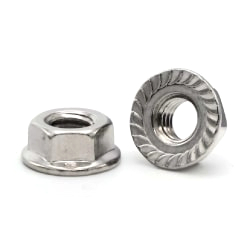
Serrated Flange Nuts
Flange nuts in 18-8, 304, and 316 stainless with teeth under the flange that bite the surface for a locking action against vibration.
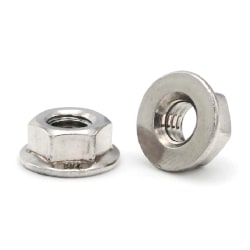
Non-Serrated Flange Nuts
Flange nuts in 304 and 316 stainless with a smooth flange face that spreads load without marring the surface, for soft and finished materials.
Serrated vs non-serrated flange nuts
The flange choice comes down to whether you want locking action or surface protection. Serrated flange nuts have teeth that bite into the material to resist loosening from vibration, ideal for machinery and equipment, while non-serrated flange nuts have a smooth flange that spreads load without marring soft or finished surfaces. Both replace a separate washer. Match the grade to the environment, with 304 or A2 for general use and 316 or A4 for coastal and saltwater exposure.
Why choose stainless steel flange nuts
- Built-in washer: the flange spreads load with no separate washer.
- Locking option: serrated teeth resist loosening under vibration.
- Corrosion resistance: 304, 316, and metric A2/A4 hold up in wet and outdoor use.
- Faster assembly: one part does the work of a nut and washer.
Flange nut types
- Serrated: teeth bite into the surface for a locking action.
- Non-serrated: smooth flange that spreads load without marring the surface.
Common applications for stainless flange nuts
- Machinery and equipment under vibration (serrated)
- Soft or finished surfaces (non-serrated)
- Automotive and trailer assembly
- Marine and coastal fastening (316 or A4)
Pair these with matching stainless bolts, and browse every flange nut style and finish on the main flange nuts category.
Stainless Steel Flange Nuts FAQ
What grades do flange nuts come in?
304 and 316 stainless, plus metric A2 and A4. A2 is comparable to 304 and A4 to 316.
Do I still need a washer with a flange nut?
No. The flange acts as a built-in washer that spreads the load, which is a main reason to use a flange nut.
When should I avoid serrated flange nuts?
Avoid them on soft or finished surfaces where the teeth would leave marks. Use a non-serrated flange nut there instead.