

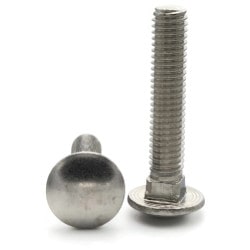
Carraige Bolts
What are carriage bolts? Carriage bolts are round, domed-head bolts with a square neck directly under the head. The square neck bites into wood or softer metal to prevent the bolt from spinning as the nut is tightened, allowing one-side installation and leaving a smooth, tamper-resistant head on the show side.

What are carriage bolts?
Carriage bolts are round, domed-head bolts with a square neck directly under the head. The square neck bites into wood or softer metal to prevent the bolt from spinning as the nut is tightened, allowing one-side installation and leaving a smooth, tamper-resistant head on the show side.
Why choose carriage bolts
- Smooth, safe head — rounded profile reduces snags and protects finished surfaces.
- One-side installation — the square neck locks into the material so you can tighten from the nut side only.
- Secure hold in wood — neck prevents rotation for consistent clamping force.
- Broad availability — inch and metric sizes, multiple materials and finishes.
Materials & finishes for carriage bolts
- Zinc-plated steel — economical corrosion protection for indoor/light outdoor use.
- Hot-dip galvanized steel — thick zinc coating for exterior construction and marine-adjacent exposure.
- Stainless steel 18-8 / 304 — reliable corrosion resistance for most environments.
- Stainless steel 316 — enhanced resistance for coastal/chloride conditions.
Common applications for carriage bolts
- Decks, docks, fences, pergolas, and site furnishings
- Playground and park equipment where snag-free heads are preferred
- Automotive and trailer wood floors, stake sides, and tie-downs
- Timber framing, agricultural equipment, and general carpentry
How to size and specify carriage bolts
Order by diameter × thread × length (e.g., 1/2″-13 × 4″, 3/8″-16 × 3″, M10 × 100 mm). Length is measured from under the head. Match thread (UNC/UNF or metric) to the nut, and choose a material/finish compatible with your washers and hardware.
Installation tips for carriage bolts
- Drill a snug round hole; lightly tap the bolt to seat the square neck before tightening.
- Use flat washers to spread load and protect wood fibers; add lock washers or threadlocker in vibration.
- On very hard species or steel, square-neck seating may need a square hole or pre-broach; avoid over-torque that rounds the neck pocket.
- For exterior builds, keep materials matched (e.g., galvanized bolt with galvanized nuts/washers) to reduce galvanic corrosion.