

Rivet Nuts
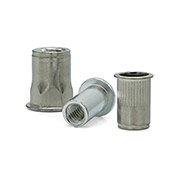
What are rivet nuts? Rivet nuts are threaded inserts that install from one side of a panel, giving you a strong machine thread in material far too thin to tap. You drill a hole, thread the tool onto the insert, and pull: the body collapses behind the panel into a bulge that clamps it in place, leaving a permanent thread on the front. Also called rivnuts, nutserts, or blind threaded inserts. AlbanyCountyFasteners.com stocks rivet nuts in 18-8 stainless and aluminum, in round smooth, ribbed, and half hex bodies, in inch and metric threads.
Rivet Nuts
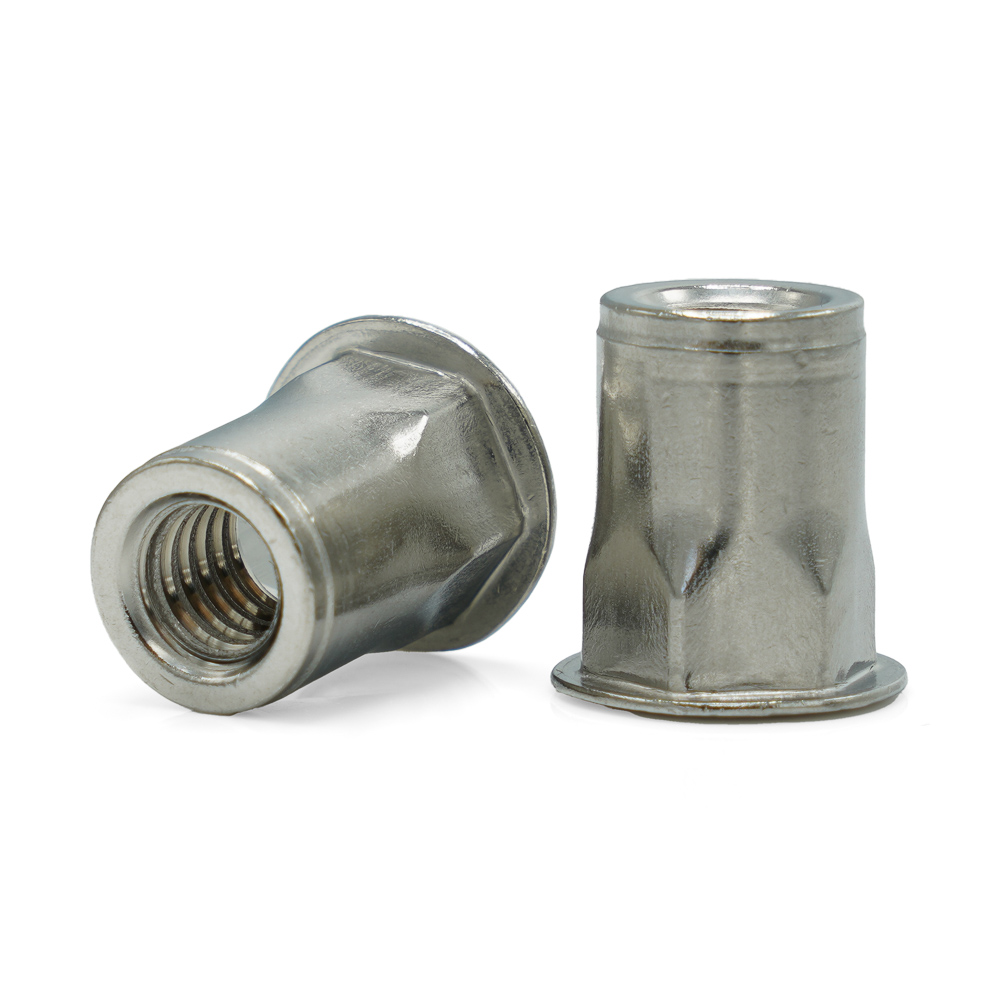
Thinwall Half Hex Low Profile Head
Rivet nuts with a hex upper body and round lower body that lock into a hex hole for strong anti-rotation while staying easier and cheaper to install than full hex.
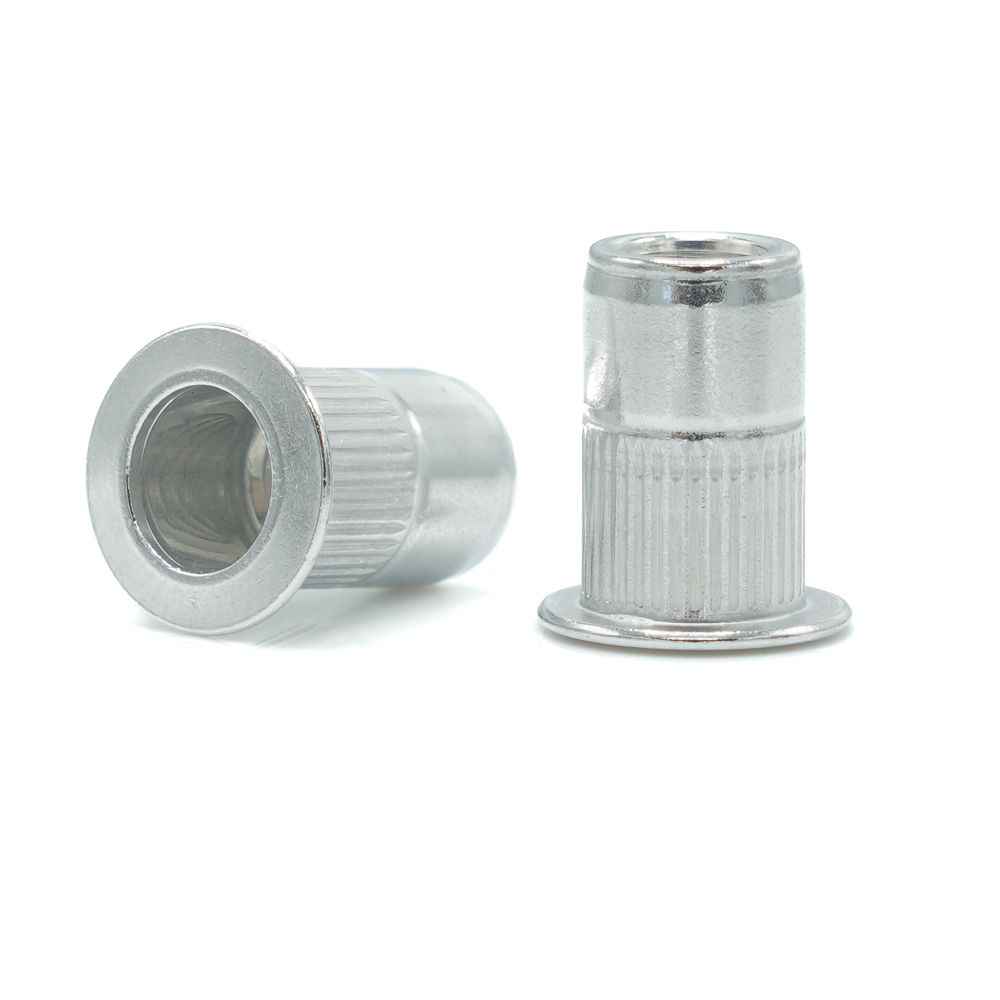
Thinwall Ribbed Low Profile Head
Rivet nuts with vertical grooves on the body that bite into the material during setting for strong anti-rotation in a standard round hole, ideal for softer metals and vibration.

Thickwall Smooth Large Head
Rivet nuts with a plain round body that install in a simple round hole, best for rigid, low-vibration assemblies where high anti-rotation isn't required.
Videos
Play videoHow do I choose a rivet nut?
Four decisions, and they interact. Body style controls how well the insert resists spinning in the hole: smooth round bodies rely on friction alone, ribbed bodies bite into the hole wall, and half hex bodies key mechanically into a matching hex hole so they cannot rotate at all. Wall thickness sets strength and grip range, with thinwall suiting sheet metal and thickwall handling heavier material and higher torque. Head style determines whether the insert sits proud or nearly flush. Material comes last but matters most for corrosion, since a steel insert in an aluminum panel corrodes the panel around every hole. Get body style right first, because spin-out is the failure mode that ruins a job.
Body styles we stock
- Round body smooth, the standard, gripping by friction against the hole wall. Simple to install in a plain drilled hole
- Ribbed and knurled, with serrations running the length of the body that bite into the hole wall to resist spin-out under torque
- Half hex, with a hexagonal section that keys into a matching hex hole, giving positive mechanical anti-rotation
Why choose rivet nuts
- Creates a strong machine thread in sheet, tube, and panel too thin to tap
- Installs blind from one side, so no access needed behind the joint
- Reusable thread that accepts a bolt repeatedly, unlike a rivet
- Much stronger than a self-tapping screw in thin material
- Available in stainless for corrosion resistance and aluminum for galvanic compatibility
Common applications
- Chassis and tube frames where a threaded point is needed in a closed section
- Sheet metal enclosures, panels, and equipment housings
- Automotive and truck accessory mounting
- Trailer and RV panel and fixture attachment
- Machinery guards and access covers removed for service
- Marine and outdoor equipment where stainless is required
You will need a rivet nut tool with a mandrel matched to the thread size, available in our rivet tools range. Where the joint needs sealing and vibration damping rather than strength, well nuts are the rubber bodied alternative.
Related Categories
Rivet Nut FAQs
What is the difference between a rivet nut and a rivet?
What you end up with. A blind rivet clamps two panels together permanently and that is the end of the job. A rivet nut installs into a single panel and leaves a threaded hole behind, so you can bolt something to it, remove it, and bolt it back. Think of a rivet as replacing a bolt and nut, and a rivet nut as replacing a tapped hole or a weld nut.
Do I need a special tool?
Yes. A rivet nut tool threads onto the insert, then pulls while holding the head against the panel, which is a different action from a blind rivet tool. The mandrel must match the thread size, so a tool covering several sizes comes with a set of mandrels.
What causes a rivet nut to spin in the hole?
Usually an oversized hole, an under-set insert, or a smooth body in material too hard for friction alone to grip. Once it spins you cannot tighten or remove the bolt normally. Ribbed and half hex bodies exist specifically to prevent this.
What is grip range?
The panel thickness the insert is designed to clamp. Below the minimum the body collapses without gripping properly. Above the maximum it cannot form a bulge behind the panel at all. Measure your material before ordering rather than assuming.
Which material should I choose?
Match the panel where you can. Aluminum inserts in aluminum panels avoid a galvanic couple. 18-8 stainless gives higher strength and corrosion resistance, and is the right call for steel panels, marine work, and anything outdoors.
Can rivet nuts be removed?
Not easily, and not without damage. Removal usually means drilling out the head and pushing the body through, which enlarges the hole. Plan the installation as permanent, and use a well nut instead if you need something removable.