

USA Made Retaining Rings and Snap Rings

What are retaining rings? Retaining rings are spring steel fasteners that seat into a machined groove on a shaft or inside a bore, forming a raised shoulder that holds a bearing, gear, pulley, or pin in position. They replace machined shoulders, cotter pins, and nut-and-washer assemblies with a lighter, lower-cost part that installs in seconds. Also called snap rings or circlips, they come in external styles that grip the outside of a shaft and internal styles that press outward against the wall of a bore. AlbanyCountyFasteners.com stocks E-style, external, and internal retaining rings in stainless steel, carbon steel, and black phosphate, in both inch and metric sizes.
Retaining Rings & Snap Rings

E-Style Retaining Rings
E-shaped rings that snap onto a shaft groove from the side to hold parts in place where axial space is tight.
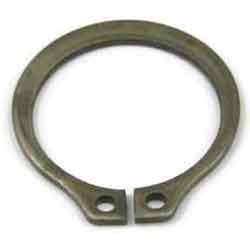
External Retaining Rings
Rings that seat in a groove around the outside of a shaft to hold parts against axial movement.
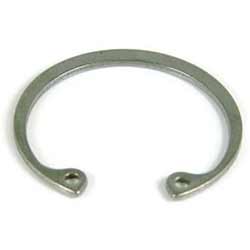
Internal Retaining Rings
Rings that seat in a groove inside a bore or housing to retain parts within it.
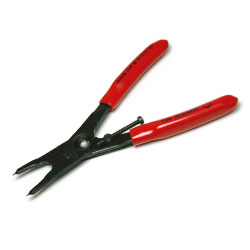
Retaining Ring Pliers
Specialty pliers that expand or compress retaining rings to install and remove them without damage.
Internal vs external retaining rings
The groove decides the ring. If the groove is cut around the outside of a shaft, pin, or rod, you need an external ring. If the groove is cut inside a bore, housing, or tube, you need an internal ring. The two are not interchangeable, and the sizing convention is different for each: external rings are ordered by the shaft diameter they grip, while internal rings are ordered by the bore diameter they expand into.
Why choose retaining rings
- Install and remove far faster than threaded fasteners, with no tapping or machining beyond the groove
- Lighter and lower cost than a machined shoulder or a nut, washer, and cotter pin stack
- Spring temper lets the ring flex during installation and snap back tight into the groove
- Available in stainless steel for corrosion resistance and carbon steel for economical general service
- Stocked in inch and metric sizes so you can match existing assemblies without redesign
Types of retaining rings we stock
- E-style retaining rings, three-pronged clips that push on from the side of the shaft, so you do not need access to the shaft end
- External bowed E rings, the same radial installation with a curved profile that adds spring preload
- External retaining rings, axially installed rings with lug holes that slide onto the end of a shaft
- Internal retaining rings, axially installed rings that compress to enter a bore and spring outward into the groove
Common applications
- Locating bearings and bushings on shafts and inside housings
- Retaining gears, sprockets, pulleys, and rollers against axial movement
- Holding clevis pins and pivot pins in linkages and actuators
- Automotive transmissions, small engines, and gearbox assemblies
- Hydraulic and pneumatic cylinders, where internal rings retain end caps and pistons
- Machinery repair and maintenance, agricultural equipment, and conveyor systems
If you know the ring pushes on from the side rather than sliding over the shaft end, start with our E-style retaining rings. For rings that seat inside a bore or housing, see our internal retaining rings.
Related Categories
- E-Style Retaining Rings
- External Retaining Rings
- Internal Retaining Rings
- Retaining Ring Pliers
- Pins
Retaining Ring FAQs
What is the difference between a snap ring and a retaining ring?
There is no real difference. Snap ring, retaining ring, and circlip all describe the same class of fastener. Snap ring is the more common shop term, retaining ring is the more common catalog and engineering term, and circlip is used more widely outside the United States.
How do I know what size retaining ring I need?
Measure the groove, not the ring. For an external ring, measure the shaft diameter where the groove is cut and order that size. For an internal ring, measure the bore diameter. Then confirm the groove width will accept the ring thickness and the groove depth matches the ring specification.
Do I need special pliers to install retaining rings?
It depends on the style. External and internal rings with lug holes are designed for retaining ring pliers, which spread or compress the ring by the lugs. E-style rings push on radially from the side and can usually be installed with a screwdriver, a small socket, or a dedicated applicator.
Can retaining rings be reused?
Sometimes, but inspect first. A ring that was installed and removed carefully and shows no permanent deformation, cracking, or loss of spring back can often be reused. Any ring that has been stretched past its elastic limit, nicked at the groove contact edge, or twisted during removal should be replaced.
Which material should I choose?
Choose stainless steel when the assembly sees moisture, washdown, outdoor exposure, or corrosive media. Choose carbon steel with a phosphate finish for dry indoor service and general machinery where cost matters more than corrosion resistance.
Which way does a retaining ring face?
Flat rings have a sharp edge and a slightly rounded edge from the stamping operation. The sharp side should face away from the retained part, so the sharp edge bears against the groove wall. Bowed rings must be oriented so the bow presses against the retained component to deliver preload.